Make sure your sound is on
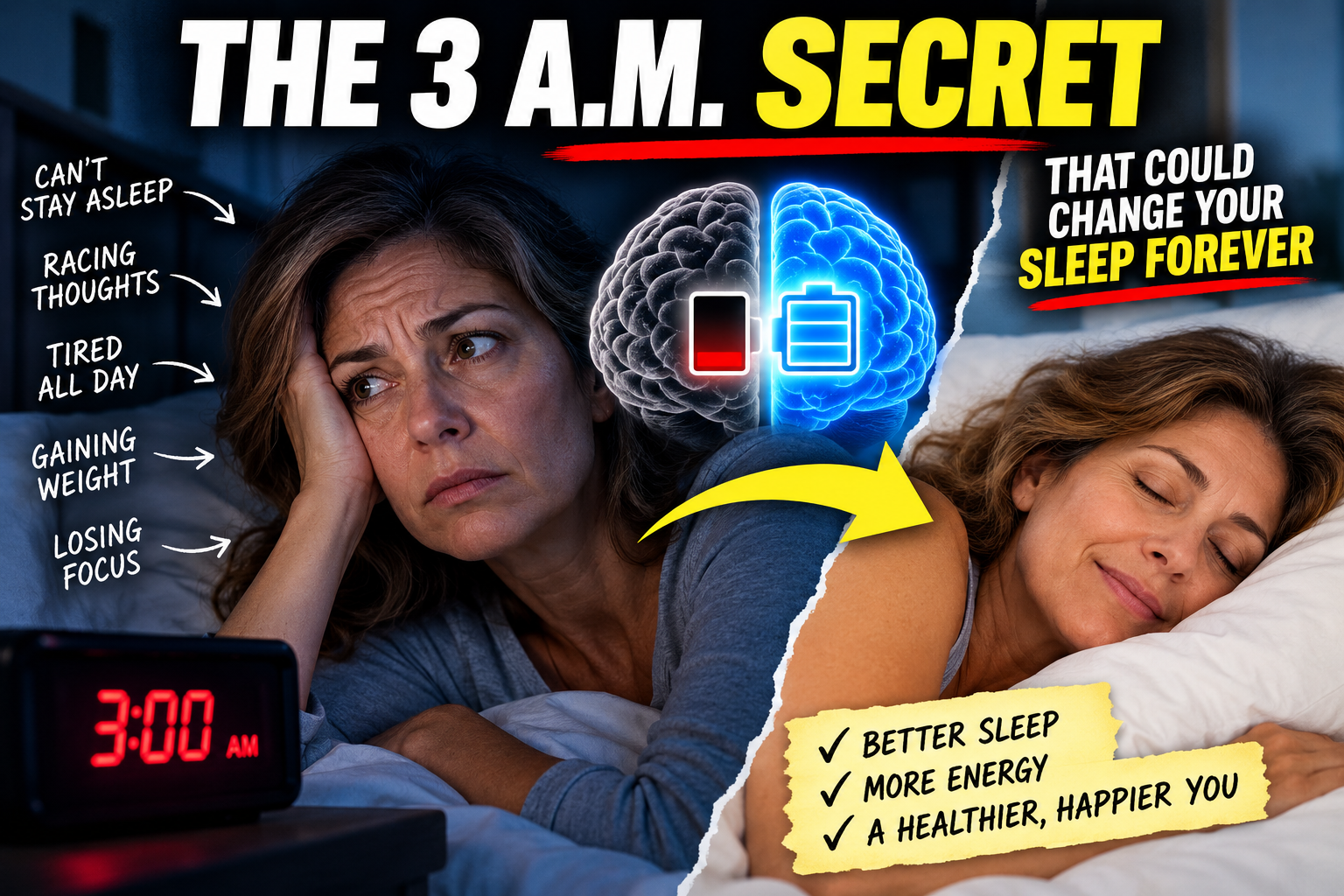
You open your eyes at 3 A.M.
Your body is exhausted, but your mind is already off to the races — work, bills, the kids, tomorrow’s schedule, and problems you have no business trying to solve in the middle of the night.
So you check the clock. You try to relax. You toss and turn knowing that, in just a few hours, you’ll have to get up and somehow function like you got a full night’s sleep.
Maybe you’ve already tried melatonin, magnesium, sleepy-time teas, meditation apps, or the “perfect” bedtime routine. And yet the same thing keeps happening… night after night.
After a while, the worst part isn’t just feeling tired.
Your focus starts slipping at work. You get more irritable at home. And important moments with the people you love can pass right in front of you while you’re physically there… but mentally running on empty.
Then the forgetfulness starts. You lose your train of thought. Words feel harder to find. Your energy isn’t what it used to be. And it’s easy to wonder, “Is this just what happens when you get older?”
That exact question is what pushed one 48-year-old journalist to dig into what was really happening with her sleep.
What she found completely changed the way she looked at the problem.
According to the sleep researcher featured in the video, the mistake may be trying to simply “force” yourself to sleep without addressing the system that’s supposed to keep you asleep in the first place.
The explanation centers around something called sleep pressure.
While much of the sleep industry focuses on melatonin, relaxation techniques, and sleep hygiene, the video claims there may be another piece of the puzzle that almost nobody talks about.
The story traces back to research conducted at Oxford in 1954 and later connects that discovery to the work of a sleep specialist who says he has spent 18 years studying how the body gets deep, restorative sleep.
At the center of the explanation is a molecule called adenosine.
Think of it like the charge inside your brain’s natural sleep battery — something that’s supposed to build throughout the day until your brain is ready to settle into deep, uninterrupted sleep.
But here’s where things get interesting.
A Seattle-based team says it combined natural compounds connected to this mechanism with a nanoemulsion technology designed to dramatically improve absorption — potentially overcoming one of the biggest limitations they observed with traditional capsules.
According to the presentation, an earlier capsule version was tested on 1,247 participants.
Later, a larger study followed 3,400 people, and the method has reportedly been used by more than 36,000 Americans.
One of the cases featured involves a woman who spent six years waking up around 3 A.M.
Her sleep score reportedly climbed from 47 to 87 in three months, while she says she also lost more than 20 pounds.
She summed up the change in just five words:
“I got my life back.”
The video available now explains why melatonin may not solve middle-of-the-night wake-ups, how the so-called “sleep pressure battery” is supposed to work, and why the technology behind this approach is different from ordinary capsules.
If you regularly wake up at 2, 3, or 4 A.M. and spend hours trying to fall back asleep, watch the full explanation and decide for yourself whether this method makes sense.
Copyright © 2024 Health Pro News LLC – All Rights Reserved
This site and the products and services offered on this site are not associated, affiliated, endorsed, or sponsored by Clickbank, nor have they been reviewed, tested, or certified by Clickbank.